
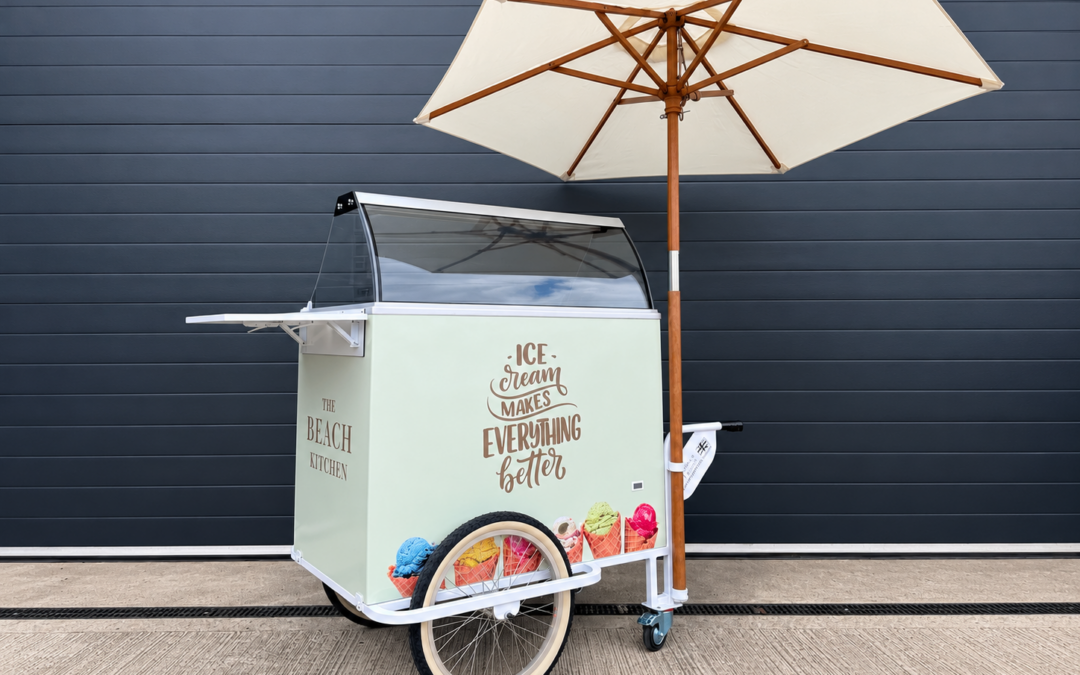
Ice cream bikes have become an increasingly popular way to serve frozen treats at events, festivals, outdoor spaces and promotional campaigns. Combining the charm of a traditional bicycle or tricycle with a purpose-built freezer, an ice cream bike offers businesses a flexible way to take their products directly to customers.
But what exactly is an ice cream bike, how does it keep ice cream frozen, and how much stock can one hold? And if you are considering using one for your business or next event, is it better to buy or hire?
In this guide, we explain everything you need to know about ice cream bikes, including how they work, where they can be used and what to consider when choosing between buying and hiring.
What Is an Ice Cream Bike?
An ice cream bike is a specially designed bicycle or tricycle that incorporates storage and cooling equipment for selling ice cream and other frozen products away from a traditional shop or ice cream van.
Unlike an ordinary bicycle, an ice cream trike is designed around the needs of a mobile food business. It typically has a large insulated or refrigerated compartment where ice cream tubs and frozen products can be stored, along with a serving area where customers can be served.
The design can vary considerably depending on the model. Some are designed to have a classic, traditional appearance, while others feature modern finishes and extensive branding opportunities.
For businesses, this combination of mobility and visual appeal can make an ice cream bike particularly useful. It can be positioned wherever customers are, rather than relying on them to visit a permanent premises.
You can explore a range of ice cream tricycles and carts designed for different types of businesses and events.
How Does an Ice Cream Bike Work?
At its simplest, an ice cream bike works by combining three key elements: mobility, storage and refrigeration.
The bike or tricycle provides the mobile platform, while the integrated freezer or cooling compartment keeps the products at an appropriate temperature. The operator can then transport the unit to a chosen location, set up the serving area and sell directly to customers.
The exact cooling system depends on the model.
Some ice cream carts use static cooling and are designed to operate from a mains power supply. For example, the Urban Classic Ice Cream Cart has a 296-litre freezer capacity, a stated temperature range of -14°C to -24°C, sliding and lockable lids, and a digital temperature display. It also includes baskets for organising stock.
Other models are designed with greater independence from mains electricity. Urban Tricycles’ 12V range, for example, combines a freezer and chiller systems.
This type of system can be particularly useful when operating at outdoor events or locations where access to a convenient power supply may be limited.
How Does It Keep Ice Cream Cold?
Keeping ice cream frozen is obviously one of the most important functions of an ice cream bike.
A purpose-built ice cream tricycle uses a dedicated cooling or freezing compartment rather than simply relying on an insulated box filled with ice. Depending on the design, the freezer may operate from mains electricity, a battery-powered system or another dedicated power solution.
Insulation helps reduce the amount of heat entering the storage compartment, while the refrigeration system removes heat and maintains the required temperature.
Some models also feature sliding or lockable lids. These are useful because they allow the operator to access products quickly while helping to limit the amount of cold air lost when the freezer is opened.
Temperature displays can also make it easier for operators to monitor the internal temperature during service.
For example, the Urban Classic Ice Cream Cart includes a digital temperature display and a temperature range of -14°C to -24°C.
When choosing an ice cream bike, it is therefore worth looking beyond its appearance. The cooling system, power requirements, capacity and ability to maintain temperature throughout an event are all important considerations.
How Much Ice Cream Can an Ice Cream Bike Hold?
Capacity varies between ice cream bikes, carts and tricycles, so there is no single standard figure.
The amount of stock you need will depend on factors such as the length of the event, expected footfall, serving size and whether you are selling individual tubs, cones, lollies or other frozen products.
As an example, the Urban Classic Ice Cream Cart has a 296-litre freezer and can display seven 5-litre Napoli tubs, with additional storage space underneath.
A larger capacity can be beneficial for busy events because it reduces the need to replenish stock during service. However, a larger unit may not always be necessary for smaller private functions.
When planning your setup, think about how many customers you expect to serve and how much product you are likely to sell per hour. It is generally better to choose a setup that comfortably accommodates your expected stock rather than selecting the largest possible freezer simply because it has more capacity.
What Does an Ice Cream Bike Setup Include?
An ice cream bike can be much more than a freezer on wheels.
Depending on the model and specification, a setup may include:
- A freezer or freezer/chiller compartment
- Storage baskets
- Serving counters or display areas
- Sliding or lockable lids
- Digital temperature displays
- Canopies or parasols
- Branding and vinyl graphics
- Hand-washing facilities
- Display trays
- Additional power packs
- Electric pedal assistance on selected models
Optional features can be particularly useful when you want the bike to form part of your wider brand identity.
For example, Urban Tricycles offers options including canopies, display screens, branding, parasols and hand-wash units across its ice cream cart range
Branding can also turn the bike into a mobile marketing tool. Rather than simply providing somewhere to serve ice cream, the tricycle can become a highly visible representation of a business, product or event.
Where Can Ice Cream Bikes Be Used?
One of the biggest advantages of an ice cream bike is its versatility.
An ice cream tricycle can potentially be used in many locations where customers gather and where the operator has the necessary permission to trade.
Common applications include:
Weddings
Ice cream bikes can provide a fun dessert option at weddings, particularly during summer celebrations and outdoor receptions. They can also offer guests something different from a traditional dessert course.
Corporate Events
Companies can use ice cream bikes as part of staff events, summer parties, launches and customer experiences. A branded tricycle can also double as a promotional feature.
Festivals
Festivals and outdoor events are natural environments for mobile food and drink businesses. An ice cream bike can be positioned in a busy area and moved or restocked according to the requirements of the event.
Markets and Street Trading
For independent food businesses, an ice cream trike can provide a way to test different locations without investing in a permanent premises.
Attractions and Visitor Destinations
Zoos, parks, gardens, leisure attractions and tourist destinations can use mobile ice cream units to create additional refreshment points in areas where a permanent café or kiosk may not be practical.
Product Promotions
An ice cream bike can also be used as a promotional vehicle. Branded frozen treats can be distributed or sold directly to customers, creating an engaging experience around a product or campaign.
Urban Tricycles specifically highlights its ice cream carts and tricycles as suitable for vendors, event caterers and independent food businesses.
Buying an Ice Cream Bike
If you intend to use an ice cream bike regularly, buying one may make sense.
The main advantage of ownership is flexibility. Once you have your own unit, you can potentially use it across multiple events, locations and trading opportunities without arranging a new hire each time.
Buying can also make sense for an established business that expects to generate revenue from the bike over a long period.
Another advantage is customisation. Depending on the supplier, you may be able to choose colours, branding and optional equipment to create a setup that fits your business.
There is, however, a larger upfront investment. You also need to consider storage, maintenance, transportation, insurance and the ongoing costs associated with operating the business.
For example, Urban Tricycles currently lists its Classic Ice Cream Cart from £1,995, while its Deluxe Ice Cream Cart starts from £3,250. These are manufacturer-listed prices and optional extras can add to the overall cost.
Hiring an Ice Cream Bike
Hiring can be a more convenient option if you only need an ice cream bike for a particular occasion.
Rather than purchasing, storing and maintaining your own equipment, you can arrange a hire for an event, campaign or short-term activation.
This can be particularly attractive for weddings, corporate events, festivals and promotional campaigns where the ice cream bike is part of the overall experience rather than a permanent business operation.
Hiring also gives you the opportunity to see how an ice cream bike works in practice before deciding whether to invest in one.
Urban Tricycles offers hire options across its range of carts and tricycles, including ice cream, coffee, cooler and promotional units.
The right choice ultimately depends on how frequently you expect to use the equipment.
Buying vs Hiring: Which Is Right for You?
The decision can be simplified by considering your intended use.
Buying may be better if:
- You plan to trade regularly.
- You want to build a long-term ice cream business.
- You need your own branding and specification.
- You expect the unit to generate revenue over several seasons.
- You want complete control over when and where it is used.
Hiring may be better if:
- You only need an ice cream bike for one event.
- You want to test the concept before investing.
- You don’t have suitable storage.
- You don’t want to deal with long-term maintenance.
- The bike is being used for a temporary promotion or campaign.
There is no universally correct answer. A business planning to trade every weekend will have very different requirements from a company looking for an eye-catching addition to a one-day summer event.
Why Choose an Ice Cream Bike?
Ultimately, an ice cream bike offers something that a conventional freezer or fixed serving point cannot: mobility.
It allows you to take your products directly to your customers while creating a distinctive visual experience. The combination of practical storage, refrigeration and branding makes an ice cream tricycle suitable for both straightforward food sales and wider promotional activity.
Modern designs also mean you don’t necessarily have to sacrifice functionality for appearance. Purpose-built units can include substantial freezer capacity, temperature controls, storage and optional features designed around the demands of serving customers.
For businesses considering an investment, the key is to choose a model based on how it will actually be used. Think about capacity, power, storage, transportation, branding and the locations where you plan to operate.
Final Thoughts
So, what is an ice cream bike and how does it work?
In simple terms, it is a mobile ice cream-selling unit that combines a bicycle or tricycle-style platform with dedicated cold storage. Depending on the model, refrigeration can be powered by mains electricity or a battery-based system, allowing operators to serve frozen products in a wide range of environments.
With capacities such as the 296-litre freezer offered by some models, an ice cream bike can accommodate a significant amount of stock while still providing the mobility needed for events and mobile trading.
Whether you are starting an ice cream business, adding a new revenue stream to an existing operation or looking for something memorable for an event, an ice cream bike can be a practical and eye-catching solution.
If you’re considering your options, take a look at ice cream tricycles and carts from Urban Tricycles to compare the different styles and configurations available.